
New World Order page

ROTHSCHILD WORLD ORDER
WHO RULES THE WORLD
?
 "Not all conspiracies are theories."
"The master planners devised
the strategy of a merger - a Great Merger - among nations.
But before such a merger can be consummated, and the United States
becomes just another province in a New World Order, there must
at least be the semblance of parity among the senior partners
in the deal. How does one make the nations of the world more nearly
equal? The Insiders determined that a two-prong approach was needed;
use American money and know-how to build up your competitors,
while at the same time use every devious strategy you can devise
to weaken and impoverish this country. The goal is not to bankrupt
the United States. Rather, it is to reduce our productive might,
and therefore our standard of living, to the meager subsistence
level of the socialized nations of the world.
The plan is not to bring the standard of living in less developed
countries up to our level, but to bring ours down to meet theirs
coming up... It is your standard of living which must be sacrificed
on the altar of the New World Order."
Gary Allen in his book "The
Rockefeller File"

DO PSYCHOPATHS RULE THE
WORLD?
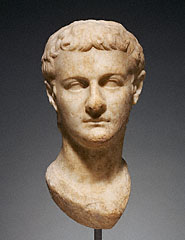 Roman Emperor Caligula
"We are ruled, though
it may be difficult to imagine, by a small dynastic power structure,
largely consisting of powerful banking families, such as the Rothschilds,
Rockefellers, and others. They emerged in controlling the financial
system, extended their influence over the political system, the
educational system, and, through the major foundations, have become
the dominant social powers of our world, creating think tanks
and other institutions which shape and change the course of society
and modern human history."
Andrew Gavin Marshall
"People, governments and
economies of all nations must serve the needs of multinational
banks and corporations."
Zbigniew Brzezinski in his book
"Between Two Ages: America's Role in the Technetronic Era",
1970
 One
World Government page - Council
on Foreign Relations, Bilderberg Group, Trilateral Commission
One
World Government page - Council
on Foreign Relations, Bilderberg Group, Trilateral Commission
"Today Americans would
be outraged if UN troops entered Los Angeles to restore order;
tomorrow they will be grateful. This is especially true if they
were told there was an outside threat from beyond, whether real
or promulgated, that threatened our very existence. It is then
that all peoples of the world will plead with world leaders to
deliver them from this evil. The one thing every man fears is
the unknown. When presented with this scenario, individual rights
will be willingly relinquished for the guarantee of their well
being granted to them by their world government."
Henry Kissinger speaking at the
annual Bilderberger meeting, May 21, 1992
Books
"The basic authority of
a modern state over its people resides in its war powers."
Report from Iron Mountain (1967)
"The war system not only
has been essential to the existence of nations as independent
political entities, but has been equally indispensable to their
stable internal political structure. Without it, no government
bas ever been able to obtain acquiescence in its "legitimacy,"
or right to rule its society. The possibility of war provides
the sense of external necessity without which no government can
long remain in power. The historical record reveals one instance
after another where the failure of a regime to maintain the credibility
of a war threat led to its dissolution, by the forces of private
interest, of reactions to social injustice, or of other disintegrative
elements. The organization of a society for the possibility of
war is its principal political stabilizer."
Report from Iron Mountain (1967)
Organizations
"In advanced
modern democratic societies the war system has provided political
leaders with ... political-economic function of increasing importance:
it has served as the last great safeguard against the elimination
of necessary social classes.
... The arbitrary
nature of war expenditures and of other military activities make
them ideally suited to control these essential class relationships.
Obviously, if the war system were to be discarded, new political
machinery would be needed at once to serve this vital subfunction.
Until it is developed, the continuance of the war system must
be assured, if for no other reason, among others, than to preserve
whatever quality and degree of poverty a society requires as an
incentive, as well as to maintain the stability of its internal
organization of power."
Report from Iron Mountain
(1967)
Documentary
Articles
"The Council [on Foreign
Relations] plays a special part in helping to bridge the gap between
the two parties, affording unofficially a measure of continuity
when the guard changes in Washington."
Joseph Kraft
"The public is irrelevant,
is understood to be irrelevant. What matters is a few big interests
looking after themselves and that's exactly what the public sees."
Noam Chomsky
"All empires have had
their pretenses justifying the expansion of one nation's influence
over others in the name of religion, freedom, combating aggression,
or exporting the standards of higher civilization. "
Robert Scheer
"Although war is "used"
as an instrument of national and social policy, the fact that
a society is organized for any degree of readiness for war supersedes
its political and economic structure. War itself is the basic
social system, within which other secondary modes of social organization
conflict or conspire. It is the system which has governed most
human societies of record, as it is today.
... The precedence of a society's
war-making potential over its other characteristics is not the
result of the "threat" presumed to exist at any one
time from other societies. This is the reverse of the basic situation;
"threats" against the "national interest"
are usually created or accelerated to meet the changing needs
of the war system.
... Wars are not "caused"
by international conflicts of interest... war-making societies
require - and thus bring about - such conflicts. The capacity
of a nation to make war expresses the greatest social power it
can exercise; war-making, active or contemplated, is a matter
of life and death on the greatest scale subject to social control.
It should therefore hardly be surprising that the military institutions
in each society claim its highest priorities."
Report from Iron Mountain (1967)
Foreign
Policy and Pentagon
Home Page