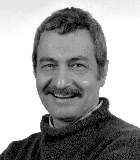
Michael Parenti
Quotes
on US foreign policy
in the Third World

from his book -- Land of Idols
Far from being reluctantly propelled into
hostilities by popular war fever, leaders incite that fever in
order to gather support for their war policies. Thereby do they
attempt to distract the public from pressing domestic matters,
serve the overseas interests of U.S. investors, justify gargantuan
military budgets, and present themselves as great leaders.
The conservative goal has been the "Third
Worldization" of the United States:
an increasingly underemployed, lower-wage work-force; a small
but growing moneyed class that pays almost no taxes; the privatization
or elimination of human services; the elimination of public education
for low-income people; the easing of restrictions against child
labor; the exporting of industries and jobs to low-wage, free-trade
countries; the breaking of labor unions; and the elimination of
occupational safety and environmental controls and regulations.
No system in history [capitalism] has
been more relentless in battering down ancient and fragile cultures,
devouring the resources of whole regions, pulverizing centuries-old
practices in a matter of years, and standardizing the varieties
of human experience.
The first law of the market is to make
the largest possible profit from other people's labor or go out
of business. Profitability rather than human need is the determining
condition of private investment.
The goal of a good society is to structure
social relations and institutions so that cooperative and generous
impulses are rewarded, while antisocial ones are discouraged.
The problem with capitalism is that it best rewards the worst
part of us: ruthless, competitive, conniving, opportunistic, acquisitive
drives, giving little reward and often much punishment -- or at
least much handicap -- to honesty, compassion, fair play, many
forms of hard work, love of justice, and a concern for those in
need.
If one looks into the genealogies of many
"old families", one discovers episodes of slave trafficking,
bootlegging, gun running, opium trading, falsified land claims,
violent acquisition of water and mineral rights, the extermination
of indigenous peoples, sales of shoddy and unsafe goods, public
funds used for private speculations, crooked deals in government
bonds and vouchers, and payoffs for political favors. One finds
fortunes built on slave labor, indentured labor, prison labor,
immigrant labor, female labor, child labor, and scab labor --
backed by the lethal force of gun thugs and militia. "Old
money" is often little more than dirty money laundered by
several generations of possession.
Generosity toward the lower classes historically
has never been an important part of upper-class awareness.
In societies that worship money and success,
the losers become objects of scorn. Those who work the hardest
for the least are called lazy. Those forced to live in substandard
housing are thought to be the authors of substandard lives. Those
who do not finish high school or cannot afford to go to college
are considered deficient or inept.
from his book -- The Sword and the Dollar
Only by establishing military supremacy
were the European and North American colonizers able to eliminate
the crafts and industries of Third World peoples, control their
markets, extort tribute, undermine their cultures, destroy their
villages, steal their lands and natural resources, enslave their
labor, and accumulate vast wealth.
The conquistador is inclined to put a
swift sword to the natives; the capitalist finds it more profitable
to work them slowly to death.
Capital requires protection, as do the
institutions through which it operates. As capital expands its
operations, the state that is associated with its protection must
develop its capacity for autocratic control. Thus, the "Free
World" increasingly resembles a dreary string of heartless
police states.
US multilateral corporations (along with
the firms of other advanced capitalistic nations) control most
of the wealth, labor, and markets of Asia, Africa, and Latin America.
This control does much to maldevelop the weaker nations in ways
that are severely detrimental to the life chances of the common
people of the Third World. The existing class structure of the
Third World, so suitable to capital accumulation, must be protected
from popular resistance. Through the generous application of force
and terror and by cultural and political domination, the imperialist
nation directly -- or through a client-state apparatus -- maintains
"stability" and prevents changes in the class structure
of other nations.
A huge national security state has developed
in the United States since World War II. Its function is to buttress
anticommunist, procapitalist governments and undermine and destroy
popular movements whenever possible.
The US government has given over $200
billion dollars in military aid to some eighty nations since World
War II. US weapons sales abroad have grown to about $10 billion
a year and compose about 70 percent of all arms sold on the international
marketplace. Two million foreign troops and hundreds of thousands
of foreign police and paramilitary have been trained, equipped,
and financed by the United States. Their purpose has not been
to defend their countries from outside invasion but to protect
foreign investors and the ruling elites of the recipient nations
from their own potentially rebellious populations.
The enormous gap between what US leaders
do in the world and what Americans think their leaders are doing
is one of the great propaganda accomplishments of the dominate
political mythology.
A nation as such does not give aid to
another nation. More precisely, the common citizens of our country,
through their taxes, give to the privileged elites of another
country. As someone once said: foreign aid is when the poor people
of a rich country give money to the rich people of a poor country.
Between 1831 and 1891, US armed forces
-- usually the Marines -- invaded Mexico, Cuba, the Dominican
Republic, Puerto Rico, Panama, Colombia, Nicaragua, Uruguay, Brazil,
Haiti, Argentina, and Chile a total of thirty-one times, a fact
not many of us are informed about in school. The Marines imtermittantly
occupied Nicaragua form 1909 to 1933, Mexico from 1914 to 1919,
and Panama from 1903 to 1914. To "restore order" the
Marines occupied Haiti from 1915 to 1934, killing over two thousand
Haitians who resisted "pacification".
The most dramatic interventionist testimonial
was given in 1935 by the US Marine Corps Commandant, General Smedley
Butler:
"I spent thirty-three years in the
Marines, most of my time being a hlgh class muscle man for Big
Business, for Wall Street and the bankers. In short, I was a racketeer
for capitalism.
I helped purify Nicaragua for the international
banking house of Brown Brothers in 1910-1912. I helped make Mexico
and especially Tampico safe for American oil interests in 1914.
I brought light to the Dominican Republic for American sugar interests
in 1916. I helped make Haiti and Cuba a decent place for the National
City [Bank] boys to collect revenue in. I helped in the rape of
half a dozen Central American republics for the benefit of Wall
Street. In China in 1927 l helped to see to it that Standard Oil
went its way unmolested.
I had a swell racket. l was rewarded with
honors, medals, promotions. l might have given Al Capone a few
hints. The best he could do was to operate a racket in three city
districts. The Marines operated on three continents."
In 1966, more than thirty years after
General Smedley Butler, another former Marine Commandant, General
David Sharp, offered this remarkable statement:
"I believe that if we had and would
keep our dirty, bloody, dollar-soaked fingers out of the business
of these nations so full of depressed, exploited people, they
will arrive at a solution of their own.... And if unfortunately
their revolution must be of the violent type because the "haves"
refuse to share with the "have-nots" by any peaceful
method, at least what they get will be their own, and not the
American style, which they don't want and above all don't want
crammed down their throats by Americans."
The writer William Shirer is quoted as
saying:
"For the last fifty years we've been
supporting right-wing governments, and that is a puzzlement to
me...I don't understand what there is in the American character...that
almost automatically, even when we have a liberal President, we
support fascist dictatorships or are tolerant towards them."
The liberal columnist Richard Cohen is
similarly befuddled:
" I dream that someday the United
States will be on the side of the peasants in some civil war.
I dream that we will be the ones who will help the poor overthrow
the rich, who will talk about land reform and education and health
facilities for everyone, and that when the Red Cross or Amnesty
International comes to count the bodies and take the testimony
of women raped, that our side won't be the heavies.
The US government is usually on the wrong
side against the poor and downtrodden, because the wrong side
is the right side, given the class interests upon which the [US]
policy is fixed.
Just as the power of the feudal aristocracy
had to be broken in order for capitalism to emerge fully, so must
imperialism and capitalism in Third World nations be overcome
if a new system is to prevail.
 Michael Parenti page
Authors
page
Home
Page